
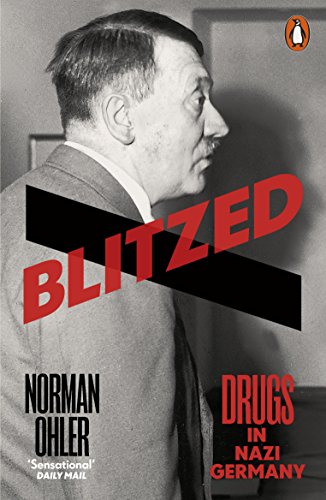
Hitler was portrayed by Nazi ideology as this clean vessel: vegetarian, a teetotaler, not even coffee, only there to be of service to the German people. That was Nazi propaganda.
Norman Ohler decided to have a closer look and went to the Federal Archives of Germany in Koblenz, where the notes of his personal physician were stored a guy called Theodor Morell, who had been a kind of VIP doctor in Berlin in the 30s and had met Hitler in 1936 during a spaghetti dinner in Munich. He became Hitler’s personal physician almost immediately because he had probiotics and cured Hitler’s chronic stomach problems and bloating. So Hitler had great confidence in this man, and actually spent every day from 1936 to 1945 with Morell. Morell was closer to Hitler than anybody else.
Norman looked at Morell’s papers in the archives, interestingly no one had ever looked at these papers. But in the Federal Archives, these weird medications actually became quite an interesting reality, because Morell meticulously noted what he gave Hitler every day. And it was quite obvious that Hitler became addicted very quickly not to a specific medicine, but to injections in general. Every day he received an injection that would optimize his performance.
In the beginning those were mostly vitamins, supplements we would say today. But in 1941, and especially in 1943 and 1944, when the war became quite difficult for Germany, he used more and more opioids. His favorite drug was Eukodal — the very opioid that is related to what later became oxycodone. It was a German patent. It was called Eukodal in Germany. The patent was lost when Germany lost the war.
Hitler was not at all a teetotaler, but actually became a junkie in 1943, and especially in 1944. He was using 20 milligrams of Eukodal intravenously every second day, which is a very high dosage.
From a childhood conversation that exposed the moral blind spots of a generation, to groundbreaking research that challenged established historical narratives, this speaker delivers a powerful exploration of how individuals and systems behave under pressure.
Blending storytelling, history, and sharp analysis, his talks leave audiences questioning assumptions and seeing both the past and present in a new light.Watch Norman Ohler’s fascinating talk delivered to the Oxford Union recently which outlines how Hilter became dependent on drugs and methamphetamine changed the trajectory of World War II.