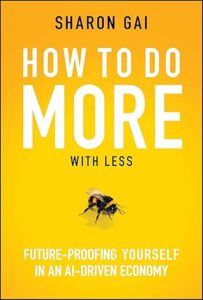
Sharon Gai is an international female keynote speaker on AI and innovation. She is the leading authority on agentic commerce. She is a former executive at Alibaba and General Manager at a billion dollar ecommerce unicorn. In her tenure, she has advised brands and heads of state in crafting their digital strategy with programmatic marketing and AI.
She has been the keynote speaker at TEDx, Singularity University, UBS, Nestle, Deloitte, and many other organizations. She has appeared on Bloomberg, Reuters, ABC, CCTV, CBC, Techcrunch, Retail Asia, and The Next Web. She is the author of the book, Ecommerce Reimagined. Sharon was also a Global Shaper in the World Economic Forum. Sharon has an Honors Bachelor’s degree in International Development from McGill and a Masters in Information Management from Columbia University.She has been the keynote speaker at TEDx, Singularity University, UBS, Nestle, Deloitte, and many other organizations. She has appeared on Bloomberg, Reuters, ABC, CCTV, CBC, Techcrunch, Retail Asia, and The Next Web. She is the author of the book, Ecommerce Reimagined. Sharon was also a Global Shaper in the World Economic Forum. Sharon has an Honors Bachelor’s degree in International Development from McGill and a Masters in Information Management from Columbia University.
Sharon helps organizations do more with less using AI and brings a fresh voice to the speaking world bridging different cultures, age groups and corporate cultures.
Topics & Talks:
How to do more with less: Future-Proofing in the Age of AI
For decades, organizations were built for human labor. Reporting lines reflected tasks. Departments reflected functions. And leaders optimized for efficiency by asking people to do more, faster. Pre AI, most of us moved through our workdays like busy bees. Email. Approvals. Reports. Meetings. Reviews. The org chart was a map of human effort. Post AI, that logic breaks. In this reflective session, we explore the shift from being busy bees to becoming “beekeepers”. Leaders must design systems, oversee swarms of digital labor, and focus human talent on judgment, taste, strategy, and trust. We will examine the most cutting edge AI tools, agent frameworks, and emerging enterprise use cases, and then step back to ask the deeper question: What does leadership look like when labor is no longer the constraint?
Key Takeaways:
A clear mental model for moving from task based org charts to capability based, AI enabled structures
Understanding the current state of AI, including frontier models, autonomous agents, multi agent systems, and enterprise copilots
A framework for identifying which roles should be automated, augmented, or elevated
How to redesign reporting lines when AI systems handle execution and humans focus on judgment
Loop Engineering: A Step Beyond Prompt Engineering
Most organizations crossed the adoption line last year. The agents are live, they are working overnight, and almost nobody can answer the follow-up question: who is engineering how they run? Sharon Gai spent years inside Alibaba watching automation absorb work that used to require hiring, and her “busy bees to beekeepers” framework has helped teams at Walmart, Coca-Cola and Mastercard make the shift from doing the work to directing it. This keynote takes on what comes after that shift. She introduces loop engineering, the practice of designing closed systems that trigger work, let AI iterate and verify itself, and escalate to a person only when judgment or risk requires it, then shows why two teams can build the identical loop and get opposite results. Audiences leave with a design pattern any non-technical team can apply (triggers, verification checkpoints, stop rules), a clear map of where human approval has to sit including cost limits and irreversible decisions, a way to spot cognitive surrender before it costs them, and a plan for moving from managing individual agents to running the system that runs them.
What if AI can do 95% of each person’s job instead of 95% of all jobs?
As AI systems are able to take on longer and longer tasks that humans were originally hired to do, knowledge workers must adapt to stay relevant. But there is also a missing piece to the puzzle. There are a wealth of things that AI is bad at: being original, critical thinking, having theory of mind and many others. Knowledge workers of today must learn this sharp difference and reorient their skills for this new age. Sharon Gai, who saw the power of Gen AI in 2018 change her team at Alibaba learned this lesson early. In this energising keynote, Sharon shows how individuals and teams can build the mindset, skills, and habits that keep them relevant and future-ready in an economy shaped by automation and intelligent tools.
Key Takeaways:
How to upgrade your mindset to stay relevant as AI reshapes every industry.
Daily practices that build adaptability, resilience, and creative thinking.
How to use AI to work smarter, not harder, so your value increases over time.
What skills matter most in an AI-powered workplace and how to develop them.
How to future-proof your career by embracing change instead of resisting it.
Testimonials
“A spectacular overview of how businesses can leverage AI in their companies today” – Lisa Driver – Walmar
“Sharon Gai showed us some of the amazing things AI can do. But she also showed us some of the risks of it. There’s plenty we can do to deal with those risks, though.” – Bradley York – CleanTelligent Software