
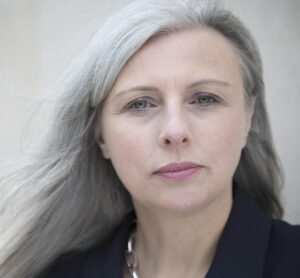
Global Futurist | Founder of Futuremade and Me:chine Institute | Global Gurus Top 30 Futurist | Forbes Top 50 Female Futurist
Tracey Follows is a globally recognised futurist whose work has evolved from just analysing trends to building an entirely new world framework for the synthetic age.
Tracey’s original concepts, which include the Me:chine Self (the synthesis of the machinable and unmachinable self that inhabits a machinic world) have positioned her as one of the most distinctive futures thinkers redefining human agency, sovereignty, and personhood for the decades ahead. And her award-winning podcast is now broadcasting the Me:chine Dialogues.
Her work has significant global impact. In 2025, as Chair of the UN/ITU Cross-Technology Working Group, she helped deliver the world’s first Global Digital Citiverse Framework, shaping international policy, ethics, and standards for virtual worlds and digital innovation.
She was the futurologist for the Royal Academy of Engineering’s Future of Engineering 2050 campaign. A compelling communicator, Tracey is one of two Resident Futurists covering products of the future on BBC Radio 4’s Dough, with media appearances in 2025 including CNN, BBC News, BBC Front Row, BBC 5Live, and exclusive interviews in The Sun and The Mirror. A popular keynote speaker she has spoken at the United Nations, U.S. State Department, FT Global Boardroom, Nobel Visions, FT Tech Live, FT Wealth Management, Finovate and Fortune Brainstorm AI, and delivers strategic foresight in executive programmes at London Business School and leading corporate academies.
Across her career, Tracey Follows has moved beyond trend commentary to create a generative worldview that helps leaders and institutions understand not only where the world is heading, but who we must become to inhabit it.
Tracey is the author of The Future of You and host of the award-winning podcast of the same name (winning Best Tech Show, Independent Podcast Awards 2023). Her new major work, Me:chine, extends her philosophical system into a practical and educational framework – forming the foundation of a new curriculum for identity and agency in the synthetic century.
Her most recent publication is “Too Much Future – Five Essays on the Age of Big Futurity – October 2026
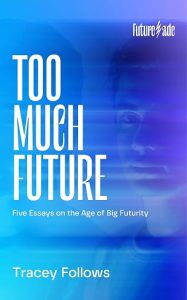
Too Much Future : Five Essays on the Age of Big Futurity by Tracey Follows
What happens when a futurist begins to wonder whether we have too much future?
Futurist and author Tracey Follows has spent her career examining what comes next. Now she turns the question back on the future-making industry itself: are we becoming so saturated with predictions that we are losing the capacity to imagine futures of our own?
Governments, corporations, consultancies and now even artificial intelligence produce forecasts, scenarios and models of what comes next on an industrial scale. Circulated relentlessly through mainstream media, digital platforms, conferences and institutional communications, these authoritative visions accumulate and reinforce one another. Individual predictions become something larger: an environment of apparent certainty about tomorrow.
Follows calls this Big Futurity: not simply the industrial-scale production of futures, but their mass mediation. Too Much Future is what it feels like to live downstream of it – overfed on other people’s futures, starved of our own.
In Too Much Future: Five Essays on the Age of Big Futurity, Follows asks who gets to imagine the future, who gets to author it, and what happens to personal agency when the system’s version of tomorrow arrives before our own.
This is a deliberately brief book: five short essays offering a concentrated exploration of ideas rather than a full-length study.
Across Five Connected Essays:
- Too Much Future investigates how predictions become an industry, then a media environment, until possibility begins to sound like inevitability.
- Haunted Futures revisits Mark Fisher’s lost futures and asks whether our abundance of forecasts conceals a shortage of genuinely different possibilities.
- Four Conditions of Futurity introduces Authored, Outsourced, Invisible and Imposed — a framework for examining our relationship to the futures being constructed around us.
- Half an Hour of Future offers a practical response through Follows’s original System & Self futures-thinking method, creating space for imagination and personal agency.
- Premature Selfhood explores how AI, algorithmic prediction and digital identity may shape who we become before we have the chance to become for ourselves.
At the centre of this collection is a proposition: Every future is written between the system and the self.
Bringing together strategic foresight, the philosophy of technology, artificial intelligence, identity and agency, these essays belong to Follows’s wider A System of Ideas — her interconnected work on technological change, futurity and selfhood in the synthetic age.
Too Much Future is not another set of forecasts. It is a futurist questioning what our culture of prediction does to our freedom to imagine and make the future.
We are being shown more futures than ever. But how many are truly ours?
Testimonals
Tracey was a truly outstanding speaker at FinovateEurope in 2025. Her Keynote exploring how AI will impact business, consumers and society was one of the most interesting and forward-looking AI presentations I have ever seen. Her commentary about blood, not data, being the new oil was truly mind blowing.
Katie Gwyn-Williams – Finovate
“Tracey is a high-impact speaker who truly does see trends in society & technology years before anyone else. She has spoken twice for FT events I’ve produced, most recently at the 2021 FT-TNW tech conference, where she delivered the closing keynote”. – Financial Times Events
“Tracey Follows’ keynote, Human. Machine. Meaning. Marketing in the Age of AI, was a standout moment at the Foresight Session 2026. She offered a thought-provoking perspective on how AI is reshaping marketing, influence and meaning—and gave our audience plenty of valuable insights to take away. Her contribution was extremely well received and added real depth to the programme.”
The Foresight Session team – Farner Consulting
The Me:chine Age
Unmachinability in a Machinic World
“Not war between humans and machinesbut a meeting of selves” – Tracey Follows
As AI, automation, and optimisation scale, human beings are increasingly required to become machine-readable – measurable, predictable, and compliant. Identity becomes infrastructure. Decision-making becomes distributed. Agency becomes quietly diluted.
This keynote introduces a clear distinction between our machinable and the unmachinable selves.
Rather than framing the future as humans versus machines, Tracey Follows explores the synthesis between the machinable and the unmachinable self – what she calls Me:chine – and why this synthesis is now essential for leadership, judgment, and responsibility.
Drawing on foresight, systems thinking, psychology, media, and lived organisational experience, The Me:chine Age shows why clarity, efficiency, and optimisation are no longer sufficient – and why human perception, temporal awareness, imagination, adaptability, and judgment are becoming the most valuable capabilities of the future.
In a world designed by machines for machines, remaining human is no longer automatic.
The New World Re-Order
The System, Self & Operating Space Between
“Every future is written between the system and the self” – Tracey Follows
This has long been the organising belief behind Tracey Follows’ work – and why, years ahead of the mainstream, she wrote a book on digital identity, exploring how future technology would reshape who we are, not just what we do. Today, that future has arrived. And it is intensifying.
Across energy, finance, artificial intelligence, digital governance, and planetary infrastructure, systems are securitising around us. They are becoming more automated, more optimised, and harder to influence once they are in motion. Power has shifted upstream into the infrastructure itself. As this happens, a new question emerges:what happens to our human agency in autonomous systems?
In this keynote, this Top 30 Futurist worldwide, shows how modern systems shape identity, agency, and productivity from the inside – and why futures that pay little attention to an interior world leave us constrained rather than empowered.
Rather than framing the future as humans versus machines, she focuses on what is unmachinable: adaptability, awareness, perception, imagination, and the ability to choose well in uncertainty. In a machine-readable world, these human capabilities become more valuable, not less.
New World Re-Order gives senior and executive leaders a clearer way to see what in the world is changing, where agency still sits, and how to operate intelligently inside powerful systems without losing authorship, ambition, or authority.

